
Your vision, our future
Submit your idea
Discover the focus areas and become a key player in the Future of energy networks.
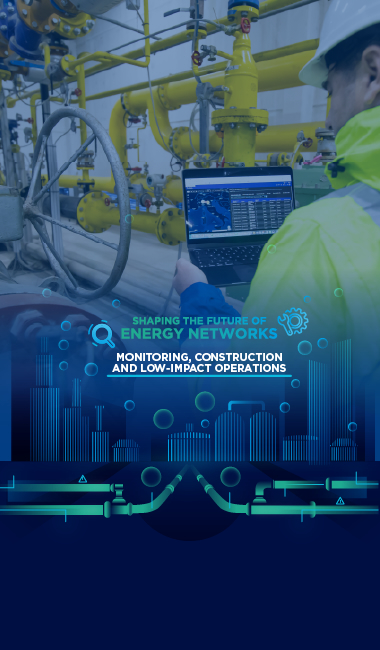
Resilient Grid
Solutions to make gas and water distribution networks smarter, safer, and more resilient to external events, as well as self-adaptive to operating conditions, through the use of both digital technologies and advanced sensors, as well as new construction methodologies.
In particular, the following areas are of interest:
Monitoring ad safety
- Continuous monitoring solutions to automatically identify and locate anomalies caused by external factors — such as third-party interference, fraudulent withdrawals, accidental damage, or weather events — with the aim of improving network safety and resilience, as well as continuously detecting gas leaks and water losses;
- Automatic monitoring systems for gas and water networks based on the use of different types of aircraft, satellites, or alternative technologies;
- AI systems to improve construction site safety, particularly in gas interception operations and in the prevention of unsafe behaviours on roadwork sites involving trench excavation and pipeline installation.
Autonomous network management
- Low-power remote control and monitoring solutions based on IoT, including systems for acquiring and regulating parameters such as odorant levels, pressure, flow rate, etc;
- Predictive and condition-based maintenance systems for networks — including road pipelines and risers — and plants/equipment, such as heat exchangers, filters, pressure reducers, etc., based on dedicated sensors or AI technologies.
Innovative solutions for the rehabilitation and replacement of network components
- Particular relevance should be given to the rehabilitation of gas risers, especially the preventive rehabilitation of connection points such as threaded joints.
AI-based design and technical support systems
- AI-based platforms interoperable with GIS and corporate systems, enabling data-driven automatic network design — including parametric and fluid-dynamic modelling — technical and economic optimization of network routes, integration of data and interferences from third-party entities, and automated generation of project documentation, such as bills of quantities, etc;
- Solutions for an “augmented workforce” — such as smart helmets, exoskeletons, sensors, or other solutions — for voice and visual reporting of on-site activities, gas detection to ensure construction site safety, targeted training to identify risk situations, and the reduction of the number of workers required for physically demanding activities.
Energy Transition
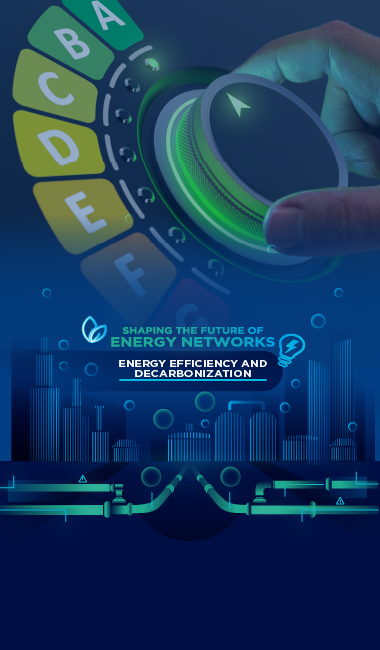
Innovative solutions to optimize the use of energy resources, accelerate the transition towards low-emission energy systems, enable the penetration of new energy carriers, and support the development of decarbonization technologies.
Energy optimization for gas and water networks
- Energy harvesting systems for gas networks and localized energy production, such as SOFCs or similar technologies;
- Technologies for reducing energy consumption in water networks, with particular interest in pumping, lifting, and water treatment systems.
Technologies for energy efficiency and the digitalization of tertiary, industrial, and residential buildings (ESCo focus)
- Technologies and solutions for reducing energy consumption in tertiary, industrial, and residential settings, with particular interest in solutions that can be integrated into ESCo/EPC (Energy Performance Contract) models and are characterized by measurable, monitorable, and bankable savings;
- Solutions for optimizing the performance of energy assets, such as thermal power plants, heat pumps, HVAC systems, photovoltaic systems, BESS, cogeneration/trigeneration systems, and energy distribution systems, through retrofitting, advanced control, predictive maintenance, and dynamic consumption optimization.
- Innovative technologies and materials for building envelope efficiency, including advanced thermal insulation systems, shading solutions, high-performance materials, coatings, and passive solutions capable of improving buildings’ energy class and supporting incentive-eligible interventions.
Digital and AI-driven solutions for energy management and the energy digitalization of condominiums and multi-tenant buildings, aimed at:
- real-time monitoring and metering of energy consumption;
- automatic optimization of loads, HVAC systems, and centralized plants;
- energy forecasting, demand response, and energy flexibility management;
- identification of anomalies, inefficiencies, and optimization opportunities;
- multi-site energy management and support for collective self-consumption/AUC;
- remote plant control and digital interaction with property managers and end users.
Digital technologies and solutions for scalable ESCo services, energy flexibility, and smart grid integration, aimed at:
- certifiable measurement of energy savings;
- integration with national and European incentives;
- load aggregation, demand-side management, and ancillary services;
- smart management of storage systems and energy flexibility;
- integration with smart grids and energy communities;
- replicability and scalability across multi-client and multi-building portfolios.
Decarbonization and synthetic methane
- CO₂ capture systems for small and medium-sized plants within the gas distribution network and for buildings in the residential, tertiary, and industrial sectors;
- Synthetic methanation solutions for small-scale applications, in combination with Power-to-Gas plants for H₂ production or biomethane production plants equipped with CO₂ capture and reuse systems.
Network construction:
Implementation of innovative and sustainable approaches for network construction, promoting the adoption of advanced technologies capable of reducing time and costs, and low-environmental-impact construction equipment, in the following phases:
- Excavation: search for new excavation methodologies (trench or trenchless);
- Installation: new pipe materials, monitoring and detection solutions for installed pipelines; new installation methodologies both for new pipeline installations and for the replacement of existing ones;
- Backfilling: new backfilling methodologies and covering materials;
- Restoration: new materials and new methodologies;
- Underwater installation: new pipe installation methodologies

Work completion and waste management:
- Waste management and disposal tools that estimate waste quantity and type;
- In-situ analysis systems for the contamination level of excavated soil and rocks to assess whether they can be reused for backfilling or not;
- Circular economy solutions that make it possible to give a second life to construction site waste, including PPE.

Network maintenance:
- Introduction of preventive and predictive strategies through the use of remote inspection tools to monitor and assess the condition of networks, identifying areas that require rehabilitation or replacement. No-dig solutions are being sought to extend pipeline life.
- Implementation of data analysis solutions to optimize networks and improve overall performance.
- Application of emerging technologies, such as artificial intelligence and IoT, based on field data, that enable the optimization of operations, accelerate network digitalization, and manage information efficiently.
